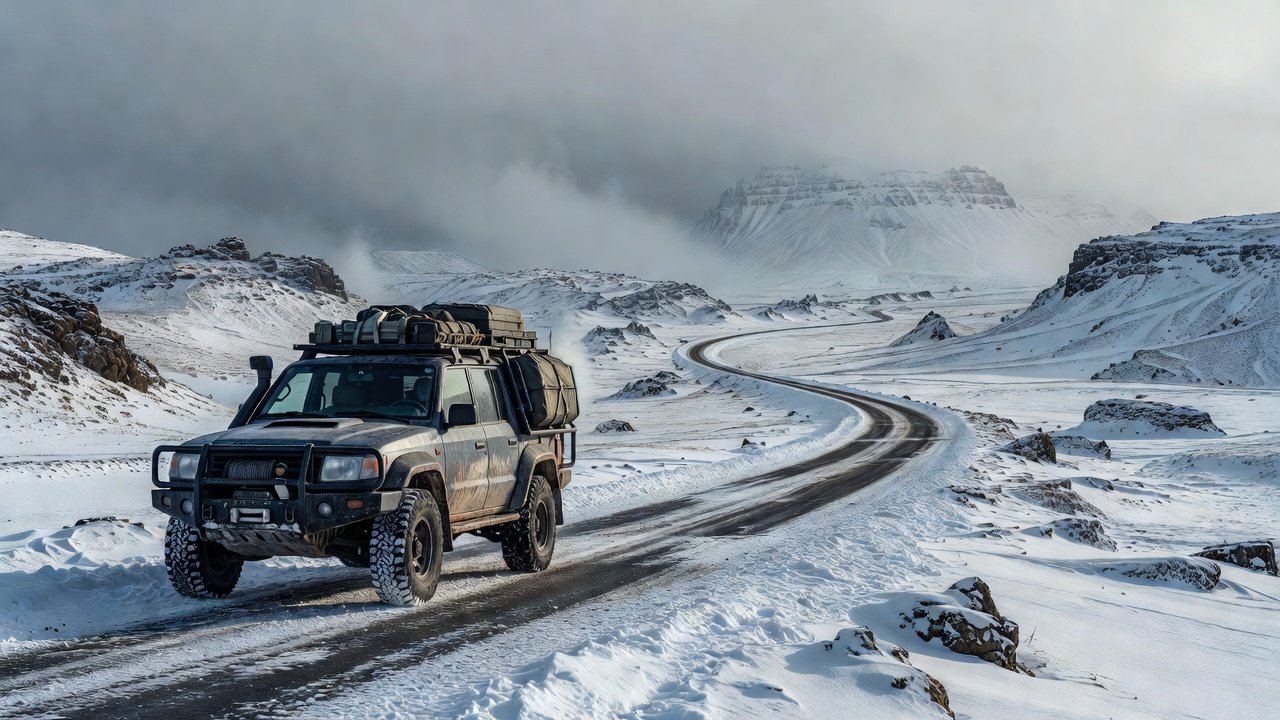
Operating a rental vehicle across Iceland between November and April is fundamentally different from continental European or North American winter commuting. Sudden ocean squalls coat basalt asphalt in wet black ice within minutes, while katabatic gusts exceeding 32 m/s (115 km/h) can rip door hinges off their mounting brackets or fling unanchored hatchbacks off unbanked road berms.
1. The Realities of 2WD vs AWD vs True 4WD
While small front-wheel-drive 2WD hatchbacks are legally permitted on the Ring Road (Route 1) during winter months, they remain the single largest cohort of vehicles requiring emergency towing by Landsbjörg search and rescue units. The key issues are lack of ground clearance and inadequate torque distribution when transitioning across plowed snow ridges.
| Vehicle Category | Ground Clearance | Traction System | Route 1 Winter Suitability |
|---|---|---|---|
| Compact 2WD Hatchback | 120 mm - 140 mm | Front-Wheel Drive open diff | Not Recommended (High stranding risk in slush/drifts) |
| Crossover AWD (e.g., Duster / RAV4) | 190 mm - 210 mm | Automatic On-Demand AWD | Certified Good (Suitable for standard Ring Road conditions) |
| Heavy 4WD (e.g., Land Cruiser / Hilux) | 220 mm - 280 mm | Selectable Low-Range & Center Lock | Optimal (Excellent stability in heavy crosswinds and deep ruts) |
2. Studded Tyres (Nagladekk): Law & Physics
Under Icelandic law, studded tyres (*nagladekk*) are permitted from November 1 through April 15. Standard winter friction tyres (all-season or non-studded winter rubber) lose substantial adhesion on wet ice when surface water lubricates the boundary layer between rubber and ice.
- Stud Composition: Tungsten-carbide pins protruding 1.2 mm to 1.5 mm penetrate sheet ice, creating mechanical interlocking independent of rubber temperature.
- Stopping Distance Difference: At 70 km/h on packed ice, studded tyres stop up to 34 meters shorter than premium non-studded all-season tyres.
- Rental Clarification: Confirm explicitly in writing with your rental supplier in Keflavík that your car is fitted with metal-studded tyres, not merely M+S (Mud & Snow) friction compounds.
Critical Door Hazard: Icelandic Gale Force Winds
Always park facing directly into the wind (*á vindinn*). When opening any car door, anchor the door handle with both hands. Wind gusts funneling down coastal cliffs like Eyjafjöll routinely exceed 35 m/s and snap metal door limiters instantly. Standard rental insurance explicitly excludes wind-blown door damage.
3. Insurance Waivers You Must Not Waive
Standard CDW (Collision Damage Waiver) policies provided by rental operators or credit card issuers leave immense financial exposure under sub-arctic conditions:
- Sand & Ash Protection (SADW): High winter gales whipping across the black sand outwash plains of Skeiðarársandur sandblast paintwork and pulverize windshield glass. Repainting a vehicle costs upwards of $4,500 USD without dedicated sand and ash coverage.
- Gravel Protection (GP): Route 1 transitions frequently onto unpaved approaches near single-lane bridges. Flying basalt gravel kicked up by oncoming trucks frequently fractures headlights and chips windscreens.
- Undercarriage & Towing Exclusion: Note that NO Icelandic rental agency covers undercarriage damage caused by ice boulders or river crossings, nor do they cover the $800 to $1,800 cost of commercial tow-truck extraction if you slide off into a snowdrift.
4. Recommended Official Resources
Before committing to a rental agreement or departing Keflavík International Airport (KEF), consult the Icelandic Transport Authority (Samgöngustofa) guidelines and official safe driving protocols:
Visit Official SafeTravel Iceland